How to Read an SNGPL Gas Bill: 7 Ultimate Tips to Understand Charges & Taxes
If you want to understand your monthly gas expenses, learning How to Read an SNGPL Gas Bill is important. Your SNGPL bill contains several details, including previous and current meter readings, gas consumption, MMBTU, GCV, gas charges, fixed charges, GST, arrears, and other adjustments. These details explain how your monthly payable amount is calculated.
Many consumers only look at the final amount and due date without checking the individual charges. However, understanding each section can help you identify unusual consumption, check meter readings, and notice unexpected adjustments.
In this guide, you will learn how to read an SNGPL gas bill step by step, understand the units used for gas consumption, and identify the charges and taxes included in your monthly bill.
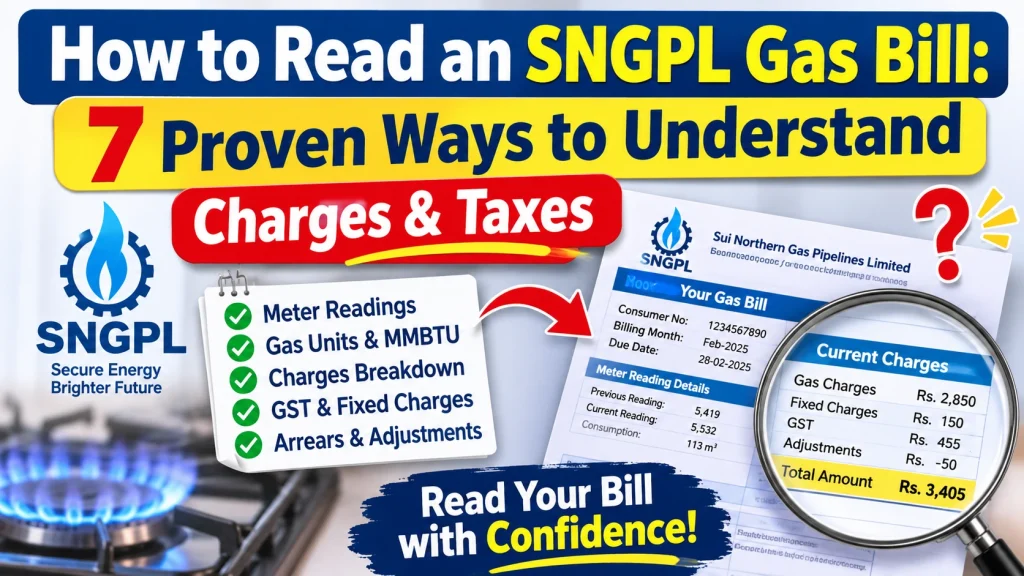
How to Read an SNGPL Gas Bill Step by Step
An SNGPL bill generally contains three main sections: consumer information, gas meter and consumption details, and current charges. Start from the top of your bill and review each section carefully.
1. Check Your Consumer Information
The top section contains your basic connection information. It helps you confirm that the bill belongs to your household or property.
Common details include:
- Consumer Number: Your unique SNGPL account identification number.
- Consumer Name: The registered name of the account holder.
- Service Address: The address where gas is supplied.
- Billing Month: The month for which the bill has been issued.
- Issue Date: The date the bill was generated.
- Due Date: The deadline for payment without applicable late-payment charges.
Always check the consumer number and address before reviewing or paying the bill.
2. Understand Previous and Current Meter Readings
The meter-reading section shows how much gas your connection has consumed during the billing period.
It normally includes:
- Previous meter reading
- Current meter reading
- Reading dates
- Difference between readings
- Gas consumption
Your basic meter consumption is calculated by subtracting the previous reading from the current reading.
Example:
- Previous reading: 5,419
- Current reading: 5,532
- Difference: 113 cubic metres
This means the meter recorded 113 cubic metres of gas during that example billing period. The actual billed consumption may also involve pressure and other conversion factors.
Compare the current reading printed on your bill with your actual gas meter. If there is a significant difference, keep a photograph of the meter and contact SNGPL for clarification.
What Are Gas Units, HM³ and MMBTU on an SNGPL Bill?
One confusing part of an SNGPL bill is that it may show gas consumption in cubic metres, HM³, and MMBTU. These terms represent different stages of measuring and calculating gas consumption.
1. Cubic Metres (m³)
Cubic metres measure the volume of gas recorded by the meter. The difference between the current and previous readings gives the basic consumption in cubic metres.
2. HM³
HM³ is a volume unit used in SNGPL billing calculations. On the bill, the cubic-metre difference may be converted into HM³ by dividing it by 100.
For example:
113 m³ ÷ 100 = 1.13 HM³
This is an illustrative calculation. Your actual bill may include additional factors.
3. MMBTU
MMBTU means Million British Thermal Units. It represents the energy content of the gas consumed rather than simply its volume.
SNGPL uses the gas volume and Gross Calorific Value (GCV) to calculate the energy quantity.
A commonly shown conversion formula is:
MMBTU = (HM³ × GCV) ÷ 281.7385
For example, if consumption is 1.13 HM³ and GCV is 933:
MMBTU = (1.13 × 933) ÷ 281.7385
MMBTU ≈ 3.74
The exact calculation should follow the conversion information printed on your bill.
Important SNGPL Gas Bill Factors Explained
Your bill may show several technical values alongside the meter readings. These values help determine the billed gas quantity and energy content.
Gross Calorific Value (GCV)
GCV represents the amount of heat energy produced by a specified quantity of gas when it is burned under defined conditions. It helps convert gas volume into MMBTU.
A higher or lower GCV can affect the calculated energy quantity even when the measured gas volume is similar.
Pressure Factor
Gas pressure affects the volume measurement. The pressure factor is used in the billing calculation to account for relevant pressure conditions.
Temperature Factor
Gas volume can change with temperature. Where applicable, the temperature factor helps adjust the measured volume for billing purposes.
Super Compressibility
This is a technical correction factor associated with the behaviour of gas under pressure. It may appear in the meter calculation section of your bill.
You do not normally need to calculate these factors yourself. However, understanding their purpose helps you read the technical information on your bill.
SNGPL Gas Bill Charges Explained
After the meter-reading and consumption details, you will find the current charges section. This section explains how your gas consumption becomes the final payable amount.
1. Gas Charges
Gas charges represent the cost of the energy consumed during the billing period. They are calculated using the billed MMBTU and the applicable tariff rates.
Your consumer category and applicable tariff slab can affect the amount charged.
2. Fixed Charges
Fixed charges are monthly charges applied according to the applicable consumer category and current tariff rules. They are separate from the cost of gas consumed.
This means a bill may contain fixed charges even when monthly consumption is relatively low.
3. Meter Rent
Meter rent is a charge shown separately on applicable bills for the gas meter service. Check the amount printed on your own bill because applicable charges can change.
4. General Sales Tax (GST)
GST is a government tax applied to applicable bill components. The amount depends on the prevailing tax rules and the taxable charges included in the bill.
Do not assume that GST is calculated only on the basic gas consumption amount. Check the bill breakdown for the actual tax amount.
5. Provisional Bill Adjustment
A provisional adjustment may appear when a billing correction or temporary calculation is applied. It can increase or decrease the amount payable.
If you do not understand an adjustment, ask SNGPL to explain the reason and the billing period it relates to.
6. Rebate or Adjustment
This section may show a credit, correction, or other adjustment applied to your account. A positive or negative adjustment can change the current bill amount.
Check the description and amount rather than assuming every adjustment is an additional charge.
7. Security Deposit
A security deposit is an account-related amount that may appear when applicable. Check the bill details or contact SNGPL if you need clarification about a new or changed deposit amount.
What Are Arrears and Late Payment Surcharge?
These two items are important because they can increase your total payable amount.
Arrears: Arrears are outstanding amounts carried forward from previous bills. If an earlier bill was not fully paid or an amount remains unpaid, it may appear in this section.
Late Payment Surcharge (LPS): This is an additional amount charged when payment is made after the applicable due date, according to the rules shown on the bill.
If you have already paid a previous bill but arrears still appear, keep your payment receipt and contact SNGPL to check whether the payment has been properly recorded.
How to Check Whether Your SNGPL Bill Is Correct
Once you understand the bill components, use these checks to review your monthly statement:
- Confirm that the consumer number and service address are correct.
- Compare the previous and current meter readings.
- Check the difference between the readings.
- Review the HM³ and MMBTU values.
- Confirm the tariff category and applicable rates.
- Review fixed charges, meter rent, and GST.
- Check whether arrears or adjustments have been added.
- Confirm the due date and total payable amount.
If any reading or charge appears incorrect, take a clear photograph of your meter and save a copy of the bill. Contact SNGPL through its official customer service channels and request a billing review.
How to View Your SNGPL Bill Online
You can use SNGPL’s official website to access available bill-related services.
Follow these general steps:
- Visit the official SNGPL website.
- Open the relevant online bill or consumer service option.
- Enter the consumer information requested by the portal.
- View the available bill details.
- Download or print the bill if the option is available.
Official website: https://www.sngpl.com.pk/
Keep your consumer number available when checking your bill online.
Frequently Asked Questions
How can I understand my SNGPL gas bill?
Start with your consumer information, then check meter readings, gas consumption, HM³, MMBTU, gas charges, fixed charges, GST, arrears, and adjustments. Each section explains part of your final bill.
What does HM³ mean on an SNGPL bill?
HM³ is a gas-volume unit used in SNGPL billing. It is commonly calculated by dividing the cubic-metre consumption by 100.
What is MMBTU in gas billing?
MMBTU stands for Million British Thermal Units. It measures the energy content of the gas consumed and is used in calculating gas charges.
Why are my SNGPL gas charges higher than expected?
Higher charges may result from increased consumption, a different tariff slab, fixed charges, taxes, arrears, or billing adjustments. Compare the current bill with previous bills to identify what changed.
What is GCV on an SNGPL bill?
GCV stands for Gross Calorific Value. It indicates the energy content of the gas and helps convert measured gas volume into MMBTU.
Why are arrears included in my SNGPL bill?
Arrears usually represent an outstanding balance from an earlier billing period. If you have already paid the previous amount, check your receipt and request account verification from SNGPL.
Conclusion
Learning How to Read an SNGPL Gas Bill helps you understand your monthly gas consumption and the charges added to your account. Meter readings, HM³, MMBTU, GCV, gas charges, fixed charges, GST, arrears, and adjustments all play a role in determining the final payable amount.
Instead of checking only the total bill, review each section carefully. Compare meter readings, keep payment receipts, and contact SNGPL if you notice an unexplained charge or incorrect reading. This simple habit can help you understand your gas expenses and identify billing issues earlier.