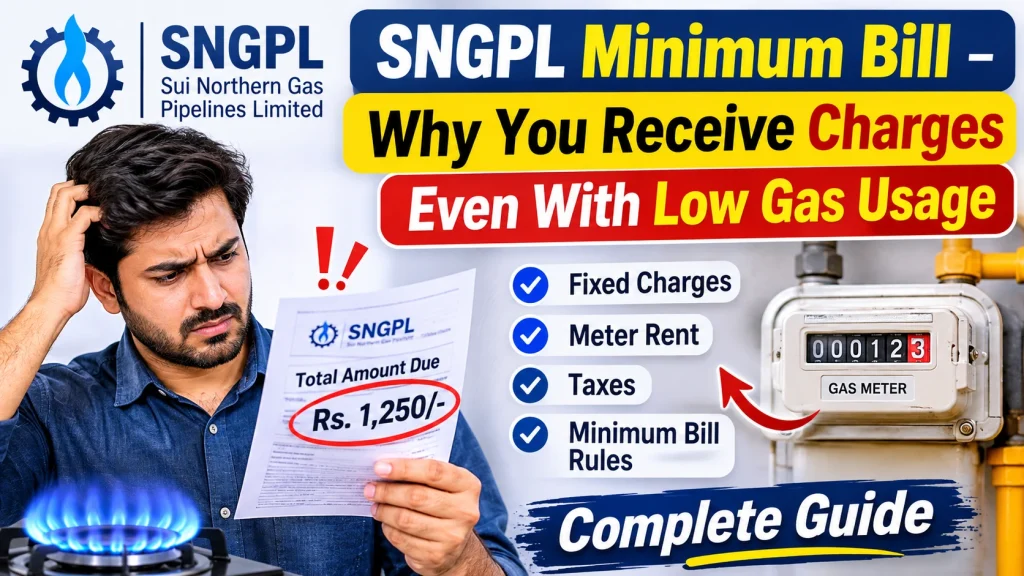
SNGPL Minimum Bill – Why You Receive Charges Even With Low Gas Usage
Many Sui Northern Gas Pipelines Limited (SNGPL) customers are surprised when they receive a gas bill despite using very little gas during the month. Some households may use their gas stove only for cooking, while others may remain away from home for several days. However, their monthly bills can still include charges even when their actual consumption is extremely low.
This situation is commonly related to the SNGPL Minimum Bill, fixed monthly charges, meter rent, applicable taxes, and other billing components. Understanding these charges can help consumers identify why they have to pay an amount even when their gas usage is limited.
In this guide, you will learn how minimum gas billing works, which charges may appear on your monthly bill, how to check your consumption, and what steps to take if you believe your bill contains an error.
What Is the SNGPL Minimum Bill?
The SNGPL minimum bill refers to the minimum amount a consumer may have to pay under the applicable gas tariff and billing rules, even when monthly gas consumption is very low.
In simple terms, your monthly gas bill is not always calculated only according to the gas units consumed. Certain fixed or minimum charges may apply depending on your consumer category, connection type, and the current tariff structure.
For example, a household that uses gas only for cooking may consume a small quantity during the billing period. However, the bill may still include fixed charges, meter rent, or government taxes.
It is important to understand that minimum billing does not necessarily mean every SNGPL customer pays the same amount. The final payable amount depends on the applicable tariff, consumer category, consumption slab, and other charges.
Why Do You Receive an SNGPL Bill With Low Gas Usage?
There are several reasons why your gas bill may remain payable even when your consumption is low.
1. Fixed Monthly Charges
One of the main reasons for receiving a bill with limited gas consumption is the application of fixed monthly charges.
These charges are not necessarily based on the quantity of gas consumed. Instead, they may apply according to your consumer category and the approved tariff schedule.
This means that reducing your gas consumption does not automatically eliminate every charge on your monthly bill.
2. Minimum Billing Rules
Gas companies operate under approved tariff structures that may include minimum charges for certain categories of consumers.
If your household consumes only a small quantity of gas, the applicable minimum billing provision may affect the amount payable.
The exact amount and conditions can change when the government or relevant regulatory authorities revise gas tariffs.
3. Meter Rent
Another possible reason for a gas bill despite low usage is meter rent.
Some consumers may see a meter-related charge on their monthly bill. This charge is separate from the actual cost of gas consumption.
You should check the meter rent section of your bill to understand whether this amount has been included in your monthly payable charges.
4. Government Taxes and Other Applicable Charges
Your gas bill may also contain taxes and other applicable charges.
Depending on the current billing rules, these may include:
- General Sales Tax (GST)
- Meter rent
- Fixed charges
- Other applicable government levies
- Previous outstanding amounts
Even when gas consumption is low, applicable taxes and charges may increase the final payable amount.
5. Previous Outstanding Balance
Sometimes, customers assume their current gas usage is responsible for the entire bill amount. However, an unpaid previous balance can also increase the total payable amount.
For example, if you did not pay your previous bill completely, the remaining amount may appear in your next billing cycle.
Always check the arrears or previous balance section before assuming that SNGPL has charged you incorrectly.
How Is the SNGPL Minimum Bill Calculated?
The SNGPL billing process involves different components. Your final bill may include the cost of gas consumed, fixed charges, meter rent, applicable taxes, and previous outstanding amounts.
A simplified explanation of the billing calculation is:
Total Payable Bill = Gas Consumption Charges + Applicable Fixed Charges + Meter Rent + Taxes + Previous Outstanding Amounts
This is a general explanation rather than an official billing formula. Actual calculations depend on the current SNGPL tariff schedule and your consumer category.
For example, consider a household that uses a small quantity of gas during a particular month. Its consumption charges may be relatively low, but additional applicable charges can make the final bill higher than expected.
To understand the exact calculation, check the individual charge descriptions printed on your monthly bill.
Protected vs Non-Protected Consumers: Why It Matters
SNGPL consumers may fall into different billing categories, including protected and non-protected domestic consumers.
These categories can affect the applicable gas rates and monthly charges.
Protected Consumers
Protected domestic consumers generally receive the benefit of the protected category under the applicable government-approved criteria.
Their classification may depend on factors such as monthly gas consumption and the relevant eligibility conditions.
Non-Protected Consumers
Non-protected consumers are billed under the applicable non-protected tariff structure.
Their gas rates and fixed charges may differ from those applicable to protected consumers.
Important: Do not assume that low usage automatically makes you a protected consumer. Always check the current official eligibility criteria and the category printed on your SNGPL bill.
How to Check Your SNGPL Bill and Minimum Charges Online
If your gas bill seems unusually high despite low consumption, reviewing the online bill is a useful first step.
Follow these steps:
- Visit the official SNGPL website.
- Find the online bill or duplicate bill facility.
- Enter your consumer number or the required billing information.
- Submit the details to retrieve your bill, if the service is available.
- Review the current billing month and due date.
- Check your gas consumption and meter reading.
- Examine fixed charges, meter rent, taxes, and previous balances.
You can also compare the current bill with your previous month’s bill to identify any sudden changes.
How to Reduce Your SNGPL Gas Bill
Although some monthly charges may be unavoidable under the applicable tariff, consumers can reduce their gas consumption by following a few practical steps.
1. Avoid Unnecessary Gas Usage
Turn off gas appliances when they are not needed. Avoid leaving your stove burning unnecessarily, especially when cooking is complete.
2. Check for Gas Leakage
A gas leak can increase consumption and create serious safety risks. If you smell gas, avoid flames and electrical switches, leave the area, and contact SNGPL through its official complaint channels.
3. Use Gas Appliances Efficiently
Use suitable cookware, cover cooking pots, and adjust the flame according to the cooking requirements. These small habits can help reduce unnecessary gas consumption.
4. Monitor Your Monthly Meter Reading
Regularly checking your gas meter can help you understand your household consumption. Compare the current reading with the previous month’s reading to identify unusual increases.
5. Review Your Consumer Category
Check whether your bill correctly shows your protected or non-protected status. If you believe your category is incorrect, contact SNGPL and request verification.
Remember that reducing consumption can lower usage-based charges, but it may not remove applicable fixed or minimum charges.
What Should You Do If Your SNGPL Minimum Bill Seems Incorrect?
If your monthly bill is much higher than expected, do not ignore it. First, examine the billing details and identify which charges have increased.
Follow these steps:
- Check whether the meter reading matches your actual meter.
- Compare your current consumption with previous months.
- Review the fixed charges and meter rent.
- Check whether previous outstanding amounts have been added.
- Verify the consumer category printed on your bill.
- Contact SNGPL to report any incorrect readings or billing issues.
- Keep your consumer number and previous bills available when submitting a complaint.
You can use the official website to access company information and available customer services:
Official Website: SNGPL Official Website
If the issue remains unresolved, ask the company about the appropriate complaint escalation procedure.
Frequently Asked Questions (FAQs)
1. Why am I receiving an SNGPL bill when I use very little gas?
You may receive a bill because of applicable fixed charges, minimum billing provisions, meter rent, taxes, or previous outstanding amounts. Your total bill is not always based entirely on gas consumption.
2. Does SNGPL charge a minimum monthly amount?
Minimum or fixed charges may apply under the approved tariff structure. The applicable amount depends on your consumer category and current billing rules.
3. Can I avoid minimum gas charges by using less gas?
Reducing gas consumption can lower your consumption-based charges. However, it does not necessarily eliminate fixed charges or other applicable billing components.
4. Why is my SNGPL bill high when my meter reading is low?
Your bill may include fixed charges, taxes, meter rent, arrears, or an adjustment. Check the detailed bill breakdown to identify the reason.
5. Do protected consumers also receive minimum charges?
Protected consumers may also have applicable monthly charges under the relevant tariff. Their billing treatment can differ from non-protected consumers.
6. How can I check my SNGPL monthly gas consumption?
You can check your current and previous meter readings on your gas bill. Comparing these readings helps you understand how much gas your household has consumed.
7. Where can I complain about an incorrect SNGPL bill?
You can contact SNGPL through its official website or available customer service and complaint channels. Keep your consumer number, meter reading, and previous bills ready.
Conclusion
Receiving a gas bill despite using very little gas can be confusing, but it does not always mean that SNGPL has made a billing mistake. The SNGPL Minimum Bill may include applicable fixed charges, meter rent, taxes, and other amounts that are not directly related to monthly gas consumption.
Consumers should carefully review their monthly bills, compare meter readings, check their billing category, and verify any additional charges. If something appears incorrect, contacting SNGPL for clarification is the best approach.
By understanding how minimum billing works and monitoring your monthly consumption, you can manage your gas expenses more effectively and avoid unnecessary confusion.