SNGPL Meter Reading and Gas Bill Charges Explained
Understanding your monthly gas bill is important for managing household expenses and checking whether you have been charged correctly. Many SNGPL consumers receive their bills without fully understanding how meter readings, gas consumption, tariff rates, and additional charges are calculated.
Your gas meter records the amount of gas consumed during a billing period. SNGPL uses this consumption information and the applicable billing rules to calculate your monthly charges.
This guide explains SNGPL Meter Reading, how to calculate gas consumption, what HM3 and MMBTU mean, and which charges may appear on your monthly gas bill.
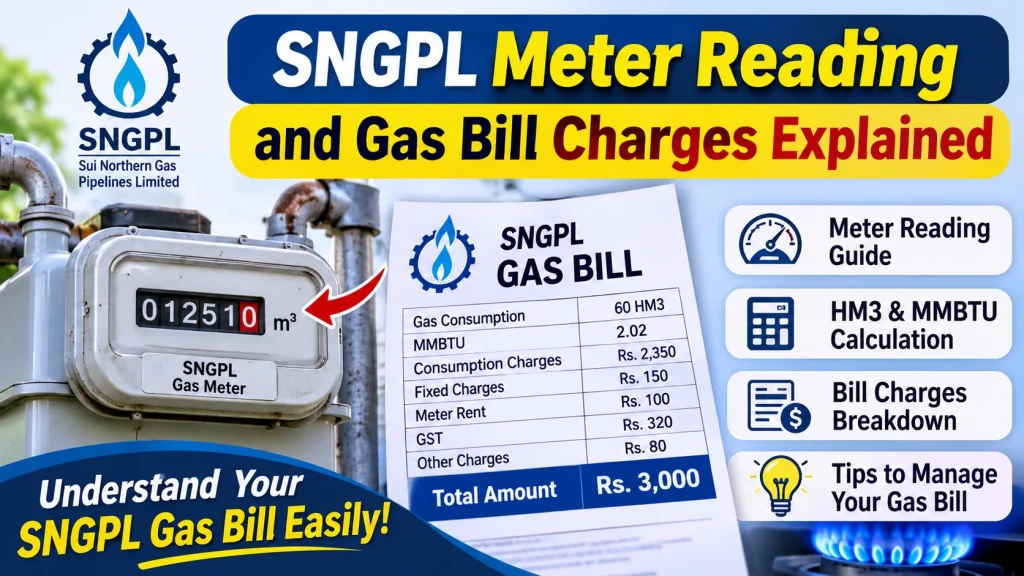
What Is SNGPL Meter Reading?
SNGPL Meter Reading refers to the recorded gas meter value used to determine how much gas a consumer has used during a billing period.
A gas meter normally displays a series of numbers. These readings help calculate the difference between your previous and current meter readings.
For example:
- Previous meter reading: 12,450
- Current meter reading: 12,510
- Gas consumption: 60 meter units
The actual billing calculation may require converting the recorded consumption into the units used by SNGPL’s billing system.
How to Check Your SNGPL Meter Reading
You can check your gas meter reading yourself by following these steps:
- Locate your gas meter, usually installed outside your home or in a designated meter area.
- Find the number display on the meter.
- Read the digits from left to right.
- Follow the meter’s instructions to identify which digits represent whole units and which represent decimal values.
- Write down the current reading.
- Compare it with the previous reading printed on your gas bill.
- Keep a record to monitor your monthly gas consumption.
For a more accurate comparison, take your reading on or close to the scheduled billing reading date.
How to Calculate SNGPL Gas Consumption
Gas consumption is generally calculated by subtracting the previous meter reading from the current meter reading.
Formula:
Gas Consumption = Current Reading − Previous Reading
For example:
| Description | Reading |
|---|---|
| Previous reading | 12,450 |
| Current reading | 12,510 |
| Difference | 60 units |
In this example, the meter difference is 60 units. However, this is not necessarily the final billed HM3 or MMBTU value. The applicable meter conversion and billing calculations must also be considered.
What Is HM3 in an SNGPL Gas Bill?
HM3 is a unit used in gas billing to represent 100 cubic metres of gas.
If your meter records consumption in cubic metres, the conversion can be expressed as:
HM3 = Cubic Metres ÷ 100
For example, if the applicable recorded gas consumption is 60 cubic metres:
60 ÷ 100 = 0.60 HM3
Your actual bill may use additional conversion factors and adjustments, so the final billed quantity can differ from a simple meter-reading calculation.
What Is MMBTU and How Is It Calculated?
MMBTU stands for Million British Thermal Units. It is a measure of the energy content of gas.
Gas billing may use MMBTU because the energy value of natural gas can vary depending on its calorific value, commonly represented by Gross Calorific Value (GCV).
A commonly used conversion relationship is:
MMBTU = (HM3 × GCV) ÷ 281.7385
Here:
- HM3: Gas volume expressed in hundreds of cubic metres.
- GCV: Gross Calorific Value of the gas.
- 281.7385: Conversion factor used in this calculation.
For example, if HM3 is 0.60 and the illustrative GCV is 950, the calculation is:
(0.60 × 950) ÷ 281.7385 = approximately 2.02 MMBTU.
This is an illustrative calculation, not a confirmed value from an actual SNGPL bill. Refer to your bill and applicable SNGPL billing information for the values used in your account.
What Charges Are Included in an SNGPL Gas Bill?
Your monthly gas bill may contain several different charges. Understanding these items helps you identify why your total payable amount changes.
1. Gas Consumption Charges
These charges are based on the billed gas consumption and the applicable tariff category or slab.
2. Fixed Charges
Fixed charges may apply according to the consumer category and applicable government-approved tariff schedule. They are not necessarily based only on the number of units consumed.
3. Meter Rent
A meter rent amount may appear on the bill where applicable under the prevailing rules.
4. General Sales Tax (GST)
Applicable sales tax is included according to the relevant tax rules and billing requirements.
5. Late Payment Surcharge
If a bill is paid after its due date, a late payment surcharge may apply according to the applicable conditions.
6. Other Adjustments
Your bill may also include adjustments, outstanding balances, or other applicable charges. Review the itemized bill rather than assuming every additional amount is a consumption charge.
Why Is Your SNGPL Gas Bill Higher Than Expected?
If your monthly gas bill suddenly increases, several factors may explain the difference.
- Higher Gas Consumption: More cooking, heating, or hot-water usage can increase consumption.
- Tariff Changes: Changes in applicable gas rates can affect the total bill.
- Seasonal Usage: Gas consumption may increase during colder months.
- Previous Outstanding Dues: Unpaid amounts from earlier bills may be added.
- Late Payment Charges: Delayed payments may increase the payable amount.
- Meter Reading Differences: A difference in reading dates or an incorrect reading can affect the bill.
Compare your latest bill with previous bills to identify what changed.
How to Report an Incorrect SNGPL Meter Reading
If you believe your meter reading is incorrect, take action promptly.
- Record the current meter reading.
- Take a clear photograph showing the meter display.
- Keep a copy of your latest gas bill.
- Compare the displayed reading with the reading printed on your bill.
- Contact SNGPL through its official customer service channels.
- Explain the difference and request a meter-reading or billing review.
- Keep any complaint reference number for future follow-up.
You can visit the official SNGPL website at https://www.sngpl.com.pk/ for company information and available customer support services.
Frequently Asked Questions
1. How can I check my SNGPL Meter Reading?
Locate your gas meter and read its displayed digits. Compare the current reading with the previous reading on your bill to understand your consumption.
2. How is gas consumption calculated?
Gas consumption is generally calculated by subtracting the previous meter reading from the current reading. Additional conversion factors may be used for billing.
3. What does HM3 mean on an SNGPL bill?
HM3 represents hundreds of cubic metres of gas. It is one of the units used in the gas billing calculation.
4. What is MMBTU in gas billing?
MMBTU measures the energy content of natural gas. It helps calculate charges based on both gas volume and its calorific value.
5. Why does my SNGPL bill include fixed charges?
Fixed charges may apply according to your consumer category and the prevailing approved tariff schedule.
6. What should I do if my gas meter reading is incorrect?
Take a photograph of your meter, compare it with your bill, and contact SNGPL to request verification or correction.
Conclusion
Understanding your meter readings and monthly charges can help you manage gas consumption and identify possible billing errors. By checking your previous and current readings, learning about HM3 and MMBTU, and reviewing the charges on your bill, you can better understand your monthly gas expenses.
Keep a record of your SNGPL Meter Reading and compare it with each new bill. If you notice an incorrect reading or unexplained charge, contact SNGPL through its official channels and request a billing review.